Traductor

martes, 26 de octubre de 2021

Mexico’s First Liberated City Commemorates Its Founding

The City of Yanga was founded after a group of enslaved Africans, led by Gaspar Yanga, rebelled against colonial rule.

Mexico has spent the year 2021 celebrating its bicentennial: it has been 200 years since the nation won its War of Independence from Spain. About two hundred years before Mexico’s independence, in 1609, the city known today as Yanga, located in the state of Veracruz, won an important battle against the Spanish crown, paving their way to freedom and becoming the first self-liberated and independent town in the Americas.

Yanga is commemorating its history with receipts: it now has digitized and certified copies of the city’s founding documents––paperwork originally received from the Spanish monarchy in 1618, now on display on the ground floor of Yanga’s city hall. To celebrate, Apolinar Crivelli Díaz, the current mayor of Yanga, recently held a ceremony with Leticia López Landero––the mayor of the neighboring city of Córdoba––where they showed off copies of Yanga’s founding papers. These copies of Yanga’s founding documents had been held for years in the archives department in Córdoba, a city initially established as a military base specifically because it was close enough to Yanga to monitor the Black population there.

Located in east-central Mexico, the city of Yanga is named in honor of Gaspar Yanga, an African who was reportedly born in 1545 and who led the rebellion that led to its founding. Yanga, who was said to be a direct descendant of royalty in either Angola or Gabon, was captured and sold into slavery in Mexico, known at the time as New Spain.

Yanga was enslaved on the Nuestra Señora de la Concepción sugarcane plantation, in an area just 93 miles from Veracruz, a major port city originally founded in April of 1519 by Spanish conquistador Hernan Cortés, who designated it La Villa Rica de la Vera Cruz (The Rich Town of the True Cross). Veracruz very quickly became an important harbor for African enslavement in Mexico. Enslaved Africans and Indigenous people were captured and sold there into a brutal caste system that privileged Spanish colonialists.

The historian William H. Dusenberry noted that, in Veracruz, enslaved Africans lived under strict laws in New Spain’s viceroyal system. Those Africans who were able to liberate themselves from slavery were treated even worse:

…the Negro or Negro woman absent from the service of his or her master for four days shall suffer fifty lashes of the whip… and if they should be away more than eight days, for a distance exceeding one league, each of them shall suffer a hundred lashes, iron fetters weighing twelve pounds shall be tied to their feet with a rope, which they shall carry for two months and shall not take off under pain of two hundred lashes for the first offense; and for the second, each shall take two hundred lashes and shall not take the weights off for four months.

Yanga would be only one of many enslaved Africans to rebel against this horrific slave system.

Yanga’s rebellion, in the year 1570, was comprised of several hundred enslaved Africans, who, once free, fled to shelter near the summit of the Veracruz mountains. Roaming from Cofre de Perote to the Sierra de Zongolica and to the highest mountain in Mexico, the Pico de Orizaba, the self-emancipated rebels established a palenque—a small town––where they could live on their own. For 30 years the Yanguícos harvested their own foods (reportedly sweet potatoes, sugar cane, tobacco, beans, chile, squash, and corn) and raised livestock. Similar to other groups who roamed the highlands, they frequently used machetes and sticks to raid supplies from passing Spanish caravans.

Locals would transport goods in caravans that traveled from the Veracruz port to Mexico City. But as African and Indigenous people fled slavery and sought refuge in the surrounding mountain range, they took to raiding those caravans. These Yanguícos were a threat to the viceroyal system’s colonial order. In 1609, when a rumor started circulating that the Yanguícos were planning to overthrow local Spanish authorities in the neighboring towns and appoint Yanga as the king, the Spanish Crown’s Viceroy Luis de Velasco sent a battalion of a few hundred troops to subdue them. Both the Yanguícos and Spanish suffered serious casualties during the ensuing battles, but Yanga and his compatriots could not be defeated. Yanga ultimately negotiated a ceasefire: the Spanish Crown consented to a treaty that in 1618 allowed the Yanguícos to establish their own government and live in peace.

PARLAMENTO INTERNACIONAL DE LÍDERES AFROS E INDÍGENAS

         Da Click aquí 👉🏾 ELAFRO 2021

viernes, 1 de octubre de 2021

ENCUENTRO AFRO '21

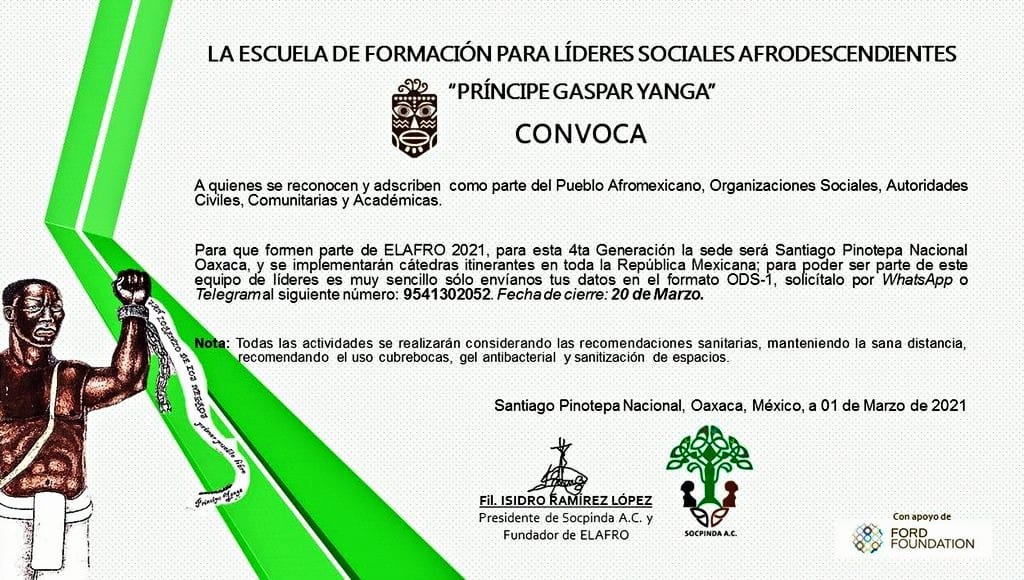
Será un Encuentro del Pueblo Afromexicano y de los Pueblos Indígenas, realizaremos mesas de trabajo, feria, resultados de la Escuela de Líderes Sociales Afrodescendientes "Príncipe Yanga". Fortaleceremos las acciones a favor de los Derechos de nuestros pueblos del 24 al 25 de Noviembre de 2021.

Requisitos: Postularse, en caso de participar de forma presencial llevar certificado de vacunación covid, cubre bocas, careta, gel antibacterial o desinfectante. 

viernes, 2 de julio de 2021

CONVOCATORIA: PARLAMENTO DE LÍDERES SOCIALES AFROS E INDÍGENAS "JAR"


CONVOCATORIA ESCUELA DE LÍDERES "PRÍNCIPE GASPAR YANGA" 2021


 VEN Y PARTICIPA DE ESTA INICIATIVA INTEGRAL A FAVOR DE LAS Y LOS NUEVOS LIDERAZGOS AFRODESCENDIENTES, SÚMATE A UNO DE NUESTRAS ÁREAS DE FORMACIÓN:

1. DECENIO INTERNACIONAL DE AFRODESCENDIENTES.

2. TERRITORIOS Y ANCESTRALIDAD.

3. DERECHO A LA EDUCACIÓN.

4. ARTICULACIÓN SOCIAL.

5. PROTECCIÓN CONTRA TODA FORMA DE VIOLENCIA, MALTRATO, ABUSO Y EXPLOTACIONES: FÍSICA, MENTAL Y/O SEXUAL.

6. REFUGIO Y PROTECCIÓN EN CUALQUIER PAÍS.

7. DERECHO A LA IGUALDAD Y NO DISCRIMINACIÓN.

8. DESARROLLO SOSTENIBLE.

9. CULTURA, DANZA Y MANIFESTACIONES ARTÍSTICAS.

domingo, 30 de junio de 2019

Boletín N°. 1888 La Cámara de Diputados reconoce a los pueblos y comunidades afromexicanas.

28-06-2019.- La Cámara de Diputados aprobó el dictamen a la minuta que adiciona un apartado C al artículo 2 de la Constitución Política, que reconoce a los pueblos y comunidades afromexicanas, cualquiera que sea su autodeterminación, como parte de la composición pluricultural de la Nación y garantiza su libre determinación, autonomía, desarrollo e inclusión social. El documento aprobado con mayoría calificada de 374 votos a favor y una abstención, precisa que según la encuesta Intercensal del Inegi de 2015, hay en el país, un millón 381 mil 853 personas que se consideran afrodescendientes. Representan 1.2 por ciento de la población nacional, 705 mil son mujeres y 677 mil, hombres. Aunque tienen presencia afromexicana en todo el país, Guerrero, Oaxaca, Veracruz, Ciudad de México y estado de México es donde habitan más personas de este sector, detalla el dictamen remitido a las legislaturas de los estados, para efectos del artículo 135 constitucional.

miércoles, 15 de agosto de 2018

ADELFO REGINO MONTES, OAXAQUEÑO COMPROMETIDO CON CAUSAS JUSTAS A GABINETE AMPLIADO DE AMLO


El oaxaqueño Adelfo Regino Montes encabezará el Instituto Nacional de los Pueblos Indígenas, organismo que operará a partir del 1 de diciembre con el nuevo gobierno presidencial.

Regino Montes es originario de Santa María Alotepec y se ha distinguido por su lucha a favor de los pueblos indígenas. 

martes, 21 de noviembre de 2017

¿Qué es una consulta previa, libre e informada?

La consulta es un derecho de los pueblos indígenas reconocido tanto en el marco jurídico internacional como en el nacional... Falta reconocer ese Derecho para Pueblos Afrodescendientes de México.

Los principios que deben fundamentar una consulta a pueblos y comunidades indígenas son:

- Previa a la toma de decisiones que los pueden afectar.
- Libre, sin coerción, intimidación o manipulación de ningún tipo.
- Informada, con conocimiento suficiente y amplio del asunto a consultar, proporcionando información comprensible y en el idioma del pueblo o comunidad.
- Realizarse de buena fe, como un diálogo genuino entre ambas partes, con respeto y el deseo sincero de llegar a un acuerdo.

Son los gobiernos nacionales quienes deben consultar a los pueblos indígenas sobre medidas legislativas o administrativas que puedan afectar su calidad de vida.